Dural's advice · drawn from the ebook “From Egg to Hen”
To warm a brooder, two options compete: the infrared lamp, the traditional choice found on every farm for the past fifty years, and the heat plate, a more recent arrival. The debate comes up with every brood. Here is what really sets them apart, point by point.
An infrared lamp draws between 150 and 250 W, switched on around the clock for several weeks. A heat plate needs only 20 to 30 W to do the same job. This isn't a difference of a few per cent — it's a factor of ten.
| Heat plate | Infrared lamp | |
|---|---|---|
| Power | 20 to 30 W | 150 to 250 W |
| Over a 4-week brood | about €3–4 | about €25–30 |
| Light emitted | None | Constant |
| Hot surface | The whole plate, gentle warmth | A scorching spot overhead |
| Lifespan | Several years | A few hundred hours |
| Heating method | By contact | By radiation |
Over a single brood, the difference is a few pounds. Over several broods a year and across several years, it ends up outweighing the price of the plate itself.
This is the argument most often overlooked, and it may be the most important. A red lamp shines non-stop. Yet chicks, like all birds, need an alternation of day and night to rest and grow properly. Under a lamp lit twenty-four hours a day, they never truly rest.
A heat plate works differently: it warms by contact, without giving off a scrap of light. The chicks slip underneath exactly as they would under a mother hen's feathers, then come back out to eat and explore. That is the natural behaviour of the species — and once darkness returns, they sleep.
An infrared bulb climbs to several hundred degrees and hangs above bedding of dry, dusty shavings. A fixing that gives way, a splash of water on the scorching glass, and the accident is instant. This isn't a theoretical risk: it's the most common cause of fire in small flocks.
A plate spreads a gentle, even warmth across its whole surface, with no hot spot anywhere. Standing on its legs above the bedding, it carries none of that danger.
The plate gives off no light and feels barely warm when you rest your hand on it. Many beginners assume it's faulty. That's normal: it's designed to warm on contact with the chicks' backs, not to heat the air in the room.
No need to measure anything: the chicks give you the answer. How they arrange themselves under the heat source tells you at a glance.
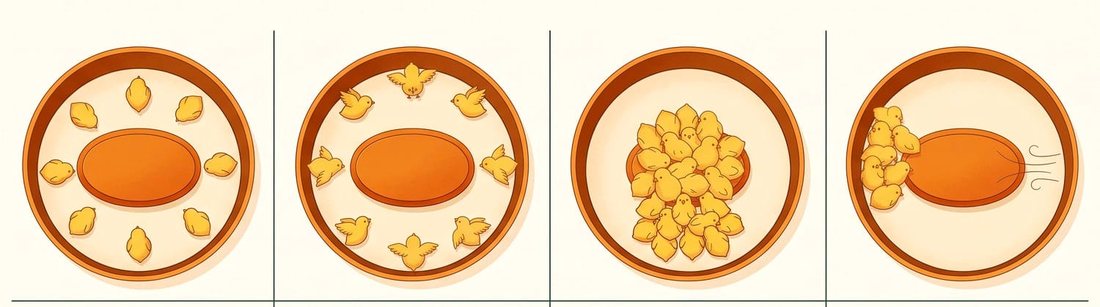 Ideal
Too hot
Too cold
Draught
Ideal
Too hot
Too cold
Draught
An infrared bulb lasts a few hundred hours and needs replacing regularly, which adds a recurring cost on top of the already high electricity bill. A good-quality heat plate lasts several years.
For cleanliness, a sloped protective cover stops the chicks perching on top and shields the surface from droppings. A wipe with a sponge is all it takes between broods.
For a family flock, the heat plate wins on every count examined here: it draws ten times less power, it respects the chicks' natural rhythm, it markedly reduces the fire risk, and it lasts years instead of weeks.
The lamp keeps some value in a very cold, poorly insulated space, where you need to warm a whole volume of air and not just the chicks. That's the only case where it remains defensible.
Once heating is sorted, water, feed and bedding remain: our article on a chick's first weeks covers each of these, and the brooder chapter of the guide sets out the week-by-week drop in temperature.